Transparencia de Fundació CODESPA Catalunya
A future for women affected by social exclusion living on the streets of Tetuán
Morocco is a country with rich cultural and geographical diversity. Its economy has experienced significant growth in recent years, driven by sectors such as agriculture, tourism, and industry, but still faces challenges in terms of social inequality and poverty.
Tetouan, located in the Tangier-Tetouan-Al Hoceima region, has always been a transit city and host to rural exodus. Since the beginning of this century, it has seen a significant influx of migrants from sub-Saharan countries. As a result, there has been a population explosion in peripheral neighborhoods, where tens of thousands of people live in extremely precarious conditions, with very limited basic services, such as health and education.
In this context, women are even more vulnerable. Despite the progress made in the country in recent years in terms of gender equality, they still face significant obstacles to accessing education and employment, which limits their participation in economic and social life. The literacy rate among women in Morocco is 65%, compared to 73% for men. And in Tetouan, the unemployment rate among women is 55.2%, and they represent 60% of the informal economy, with lower wages and greater job insecurity. This situation is even more worrying for migrant women, who lack a supportive family environment.
The CODESPA Foundation is working with APISF (Association for the Protection of Children and Family Awareness), a local partner, on a project to help young people and women living on the streets of Tetouan in vulnerable situations and extreme poverty. Most of them are victims of violence and human rights violations who lack opportunities to live in a safe environment and decent living conditions.
Through this intervention, comprehensive support is provided to young Moroccan and sub-Saharan African women and women with children who are outside the social protection system, facilitating their social and economic reintegration and ensuring a decent livelihood. To this end, they are welcomed into Shelters, where work is carried out along two lines. On the one hand, they are offered a safe environment through housing, food, and medical and psychosocial care, so they can recover physically and emotionally. On the other hand, their access to employment and/or self-employment is encouraged, allowing them to achieve economic independence. To this end, different programs are offered, depending on the young women’s educational level: basic education courses for schooling, literacy training, vocational training, and/or entrepreneurship.
Dinar: from invisibility to recognition and autonomy
Dinar Raoui’s story is the story of one of the women who has been part of this CODESPA project.
Dinar lived outside the system since birth. She was never registered in the civil registry, so she had no ID card, no right to schooling, medical care, or any other basic services. From a very young age, she was forced to work selling pastries on the street, alongside her younger siblings, to contribute to the family’s survival.
One of APISF’s partner community associations identified her and included her in one of the project’s shelters, where she received comprehensive support. With the support of the legal and administrative team, she began a long process to obtain personal documentation and thus be legally recognized by the Moroccan state.
At the same time, she received specialized psychological care that helped her overcome years of exclusion and exploitation. She also participated in soft skills sessions to improve her self-esteem and social skills, as well as literacy workshops, where she learned to read and write for the first time. Afterward, she began a vocational training course in pastry making, after which she completed an internship at the catering company “Traiteur Anouar,” which has several restaurants throughout the city of Tetouan and decided to offer her a permanent job at the end of the internship.
For Dinar, this job represents much more than a source of income. It’s a symbol of her independence, her regained dignity, and the opportunity to take care of her younger siblings.
“Before, I didn’t exist for the system. Now I have a document, a job, and a path. For the first time in my life, I can think about my future and that of my siblings”, she says excitedly.
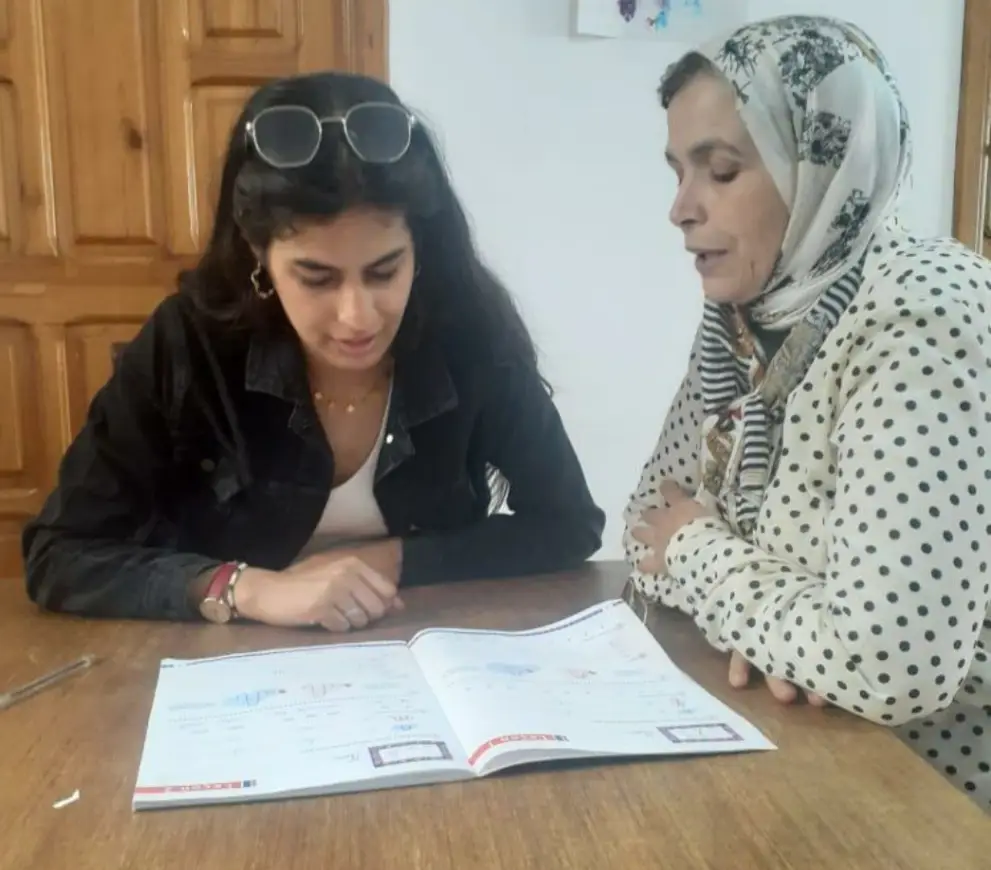
The opportunity to start over
Dinar is one of the many women we’ve been able to help with this project, the end of which marks a new beginning for all of them. They now have the emotional resources, personal and social skills, and technical training they’ve acquired to build a better future for themselves, their families, and their communities.