Transparencia de Fundació CODESPA Catalunya
Strengthening of the city of Tetouan with the participation of vulnerable youth, and facilitating their access to decent employment
In 2013, a collaboration between the CODESPA Catalunya Foundation and the Barcelona City Council began, within the context of the Cooperation Program for Global Justice in Specific Cities, with the aim of strengthening local governance in the Tetouan City Council. To this end, CODESPA teams and the ATIL Association, as a local partner, provided technical assistance, in a participatory process, to the various stakeholders involved: the Social Action Division of the Tetouan City Council, Civil Society Organizations (CSOs), and young people from the most vulnerable neighborhoods of Tetouan. This has also helped boost the participation of these young people, who are experiencing social exclusion, in the public policy of their city.
The latest project carried out within this collaboration, which began in December 2022 and ended in November 2024, focused on facilitating young people’s access to decent employment by promoting dialogue, participation, and consultation in the Tetouan City Council.
This initiative directly addressed the challenges of youth employment in a local context marked by high unemployment, focusing on the city’s peripheral neighborhoods, where residents have limited resources and infrastructure. To this end, the project has focused from the outset on cross-sector collaboration, bringing together the Tetouan City Council, public stakeholders, CSOs, and the private sector around a common vision. This approach has allowed:
- Consolidate the consultation with a variety of stakeholders through the initial assessment that mobilized young people from diverse backgrounds (secondary school students, NEET (Not in Education, Employment, or Training), young people in training, members of associations) and other public and private stakeholders:
- Strengthen the capacities of council officials who actively participated in the development and appropriation of intervention methodologies, and who laid the foundations for a more effective and sustainable guidance system.
- Establish an innovative career guidance model, adapted to local needs and based on an inclusive methodology that involves all participants.
- Facilitate the planning of key activities, such as career guidance workshops and training tailored to the needs of young people.
This intervention has achieved, through training, support, and a cascading impact on two levels. On the one hand, it has strengthened the capacities of the Tetuán Council Social Action Division by developing a public employment mediation and guidance service in its outreach offices in Tetouan’s neighborhoods. On the other hand, it has enabled young people to access these services and opt for decent employment and/or self-employment.
Participatory Processes
The success of this intervention is largely due to the participatory methodology followed, encouraging the involvement of the various stakeholders involved, both public institutions and citizens, to identify the most appropriate needs and proposals, their implementation, and subsequent management, making them their own.
A selection of 572 young people, 465 of them women, who live in the city’s peripheral neighborhoods and are at greater risk of exclusion, actively participated in the assessment, which allowed their opinions to be gathered on the challenges and opportunities related to their employability. To this end, discussion groups, focus groups, and structured interviews were created to maximize their participation. These spaces encouraged transparent participation, highlighting solutions tailored to the identified needs, ensuring that young people could access a public employment guidance service and training services to gain employment and/or self-employment.
The training and support for 27 officials, 16 of them women, from the Tetouan City Council Social Action Division to design and formalize the public employment service have played a key role. Their participation in interactive training workshops and consultation meetings helped strengthen institutional capacities and foster ownership of the career guidance and integration system methodology, ensuring the systems’ smooth integration into existing structures.
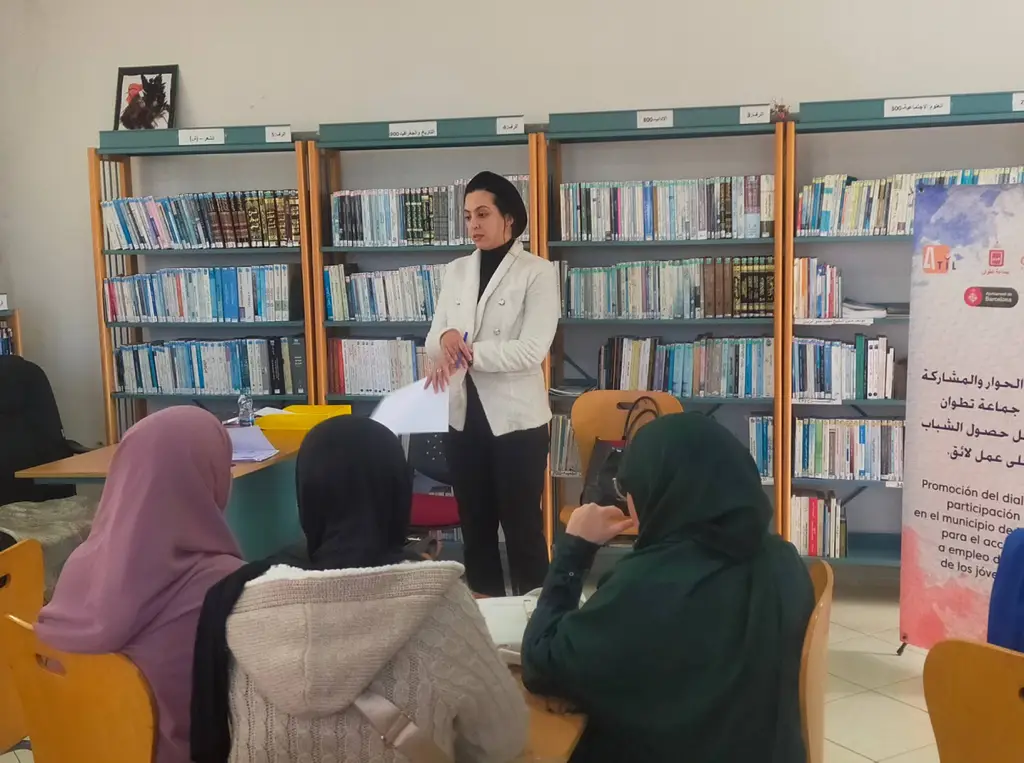
30 young leaders from civil society organizations, 8 of them women, also played a key role in developing the public employment services model, providing their perspectives on the needs of young people and the resources available for their guidance and professional integration. They also contributed to the creation of a detailed mapping of local resources and the identification of synergies with other local and regional initiatives. These stakeholders also participated in collective guidance workshops held in local libraries.
Regular meetings and technical exchanges were organized to establish strong links between the various stakeholders. These coordination mechanisms ensured effective collaboration, optimized the involvement of each stakeholder, and maximized the impact of joint actions, thus strengthening the local governance ecosystem and ensuring the sustainability of the results achieved.