Transparencia de Fundació CODESPA Catalunya
Strengthening bio-entrepreneurship as a sustainable livelihood for Waorani women in the Ecuadorian Amazon.
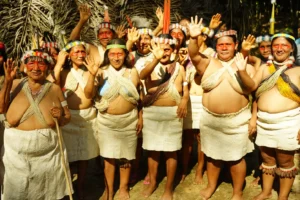
Between January and December 2023, the CODESPA Foundation carried out the project “Economic Recovery and Sustainable Livelihoods for Waorani Women in the Ecuadorian Amazon, Promoting Their Economic, Social, Cultural and Environmental Rights (ESCER) and Gender Equality”, thanks to the support of ACCD (Catalan Agency for Development Cooperation). The objective was to contribute to improving the income of Waorani women by strengthening their social and business leadership and the leadership of the Association of Waorani Women of the Ecuadorian Amazon (AMWAE) for the marketing of their handicrafts, on the one hand; and, on the other, by raising awareness about the exercise of their rights from a gender perspective, with the support of local authorities.
The Waorani people
The Waorani are an indigenous people who first came into contact with the Western world in the mid-20th century, with the arrival of the rubber, oil, and timber extraction industries. They are currently continuing their adaptation process but still face significant gaps in economic and social inequality. The territory they inhabit, in the heart of the Ecuadorian Amazon, is of great biological and cultural value. The pursuit of sustainable livelihoods that avoid deforestation and the hunting of native species, and that allow for their economic development while respecting the environment, is key to their survival.
Strengthening handicraft enterprises
AMWAE selected a new management team at the end of 2022, so this project has provided a great opportunity to support and train the eight female directors in their process of strengthening their social and business relationships. The Gender-Related Leadership Workshop they attended aims to enable them to perform effectively as leaders in their communities.
Furthermore, to strengthen AMWAE’s bio-entrepreneurial handicraft sales, a comprehensive strategy with a value chain approach has been implemented, which has helped promote alternative ways of generating income. To this end, various training activities on business topics, digital culture, and new handicraft designs have been carried out for the training of middle managers and, at the same time, foster generational renewal within AMWAE.
These include:
- With the support of the CODESPA Foundation, AMWAE’s management and technical team has developed a business plan to achieve medium- and long-term goals and objectives. This plan, along with the marketing plan, has allowed them to establish strategies to increase sales and ensure the future sustainability of their bio-enterprises. Thus, 28 women leaders have attended the “Successful Management of MSMEs” workshop, which offers techniques and strategies for managing micro and small businesses, with the goal of strengthening their organization and business skills. This workshop also includes a certificate endorsed by the Ministry of Labor.
- 100 women associated with AMWAE have participated in two workshops on craft design and innovation, focusing on the development of new designs, taking into account which ones are most appropriate to their abilities and best adapt to the niche market demand for Waorani crafts.
- 20 young people attended a communications workshop, with training in digital topics, office automation, and social media, focused on marketing. The workshop aimed to strengthen AMWAE’s commercial skills and encourage young Waorani women to pursue their own businesses related to their people’s traditional crafts. This also aims to foster generational renewal within the association.

Among the achievements of AMWAE’s directors are the efforts made to acquire clients in cities such as Francisco de Orellana, Tena, Puyo, and Quito. They have also been invited to participate in several events to promote and raise awareness about the association’s comprehensive activities.
Also, thanks to a mutual cooperation agreement signed by AMWAE with the Intiñan Site Museum, they have a presence in the themed shop located inside the museum, which welcomes tourists from all over the world throughout the year. Waorani women visit on weekends, allowing them to explain the life of their people and promote the shop’s crafts.
All of this has resulted in an 87% increase in sales, more than expected, due in part to a slight recovery in tourism following the pandemic. For the 100 artisan women from Toñampare and the surrounding area who have participated in the project, their monthly income has increased by an average of 12.6% with the sale of their crafts to AMWAE.
Compliance with the Economic, Social, Cultural and Environmental Rights of the Waorani
Another important aspect of this project has been raising awareness among AMWAE women members and their communities about exercising their rights and adopting practices that foster a culture of peace. To this end, two promoters have been trained in ESCER (Educational Responsibility) and, at the same time, regular visits have been made to the territory to raise awareness among Waorani communities about environmental conservation, human rights, health, and gender. Among the activities carried out, the following are worth highlighting:
- The work carried out by two health brigades in hard-to-reach communities has provided care to 281 people, 199 of them women. Special attention has been paid to raising awareness among women so they can access gynecological and obstetric examinations, providing care to pregnant women, vaccinating infants to complete or begin their basic vaccination schedule, providing special care to the elderly, and providing dental care, among other services. One of the success factors of these brigades is that the facilitators were Waorani women directors of AMWAE.
- The association’s directors have also participated in several events, in collaboration with the Pastaza provincial government, where, through the exhibition of their work, they raise awareness among citizens about the environmental problems caused by extractive companies that threaten the territory, as well as their efforts to preserve its history and culture.
According to a traditional Waorani song: “As our grandmothers taught us to weave and protect the forest, to walk freely and happily, to sing like birds, so we will raise our daughters, as our grandmothers taught us”.