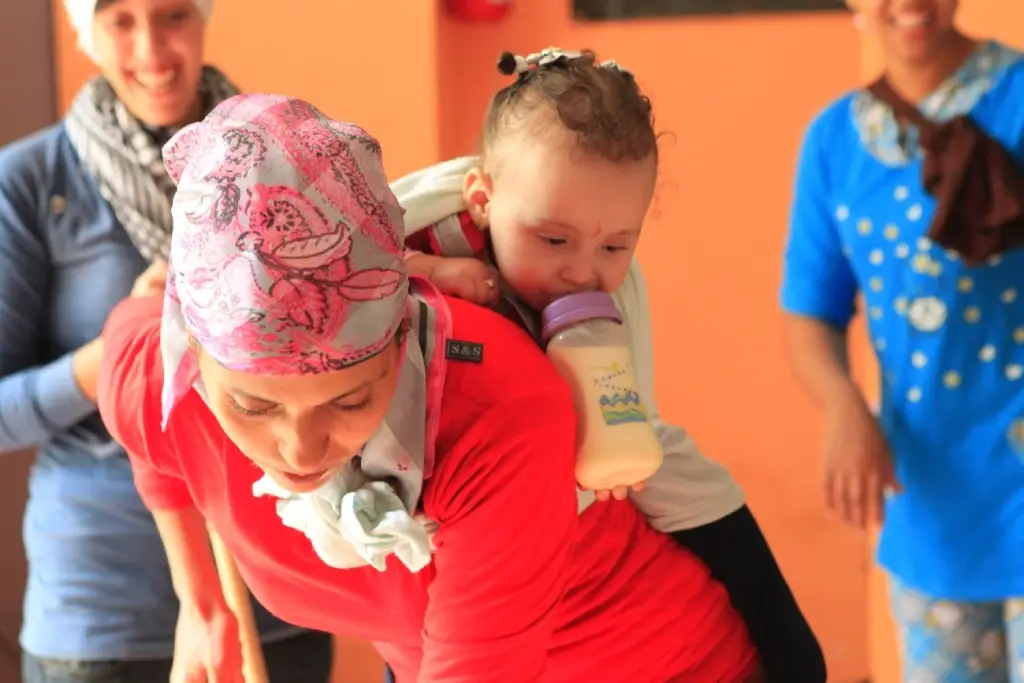
Vocational training and job placement support for single mothers in Tangier, Morocco.
Country: Morocco.
Location: Tangier.
Duration: January to June 2017.
Participants: 30 single mothers, aged 20 to 30, living in a socially at-risk context, and 30 children aged 0 to 3.
Area of specialization: Vocational training and micro-entrepreneurship.
Starting point
Since 2004, Moroccan family law has been governed by a new code, the Moudawana, which contains certain advances for women’s rights, although it is still insufficient and lacks much practical development.
In Morocco, unwanted pregnancy goes against the country’s cultural, social, and religious norms. This results in the exclusion of single mothers from their communities, leaving them marginalized. Added to this is the psychological and health fragility experienced by pregnant women, who cannot count on the support of their families or the biological father.
This situation, coupled with the great economic hardship in which they live, creates situations of extreme socioeconomic vulnerability for both mother and newborn. Often, women feel forced to give their child up for adoption because they cannot meet their basic needs.
The lack of opportunities for young single mothers, who often have no education or have dropped out of school, necessitates intervention and support to facilitate their economic independence and support for their families.
Objective
Provide access to vocational training and job placement guidance tailored to 30 young women, single mothers, living in socially at-risk contexts.
What is the project about
The project implements an inclusive and accessible Vocational Education, Training, and Job Placement (EFIP) model for particularly vulnerable populations. It will offer opportunities to young people who have dropped out of school and are in poverty and are excluded from the current system, resulting in their social and labor exclusion due to professional qualifications that do not meet the needs of the labor market.
This is achieved through two main vocational training components:
Transversal skills, life skills, and job search techniques: training that increases your ability to find paid employment.
Professional training in a trade, through theoretical and practical training as a childcare assistant, has been identified as having high employability potential in this area.
These activities will improve the young women’s educational and vocational training levels to facilitate their employment.
During these women’s training, their children will have access to childcare to facilitate their work-life balance.