Reducing Wealth Inequality and Promoting Green Transition in the Philippine Seaweed Value Chain, Phase II.
- Country: Philippines
- Location: Island barangays within the jurisdiction of Surigao City, Surigao del Norte, Mindanao Island
- Duration: February 2025 to January 2027
- Participants: 400 small-scale seaweed farmers from Surigao del Norte (50% women) in addition to 1,000 producers from Surigao del Sur. A total of 1,400 direct participating families and 7,000 indirect beneficiaries
- Area of specialization: Rural market development, microentrepreneurship training
Starting point
In the provinces of Surigao del Sur and Surigao del Norte, in the Caraga Region, on the island of Mindanao, 80% of the population lives in rural areas and 40% lives in poverty. Their main source of livelihood is fishing and marine agriculture, and many families make a living from artisanal seaweed production. These small-scale farmers are independent, with low individual production capacity, and are unorganized. Furthermore, they lack technical knowledge and have difficulty accessing supplies, financial services, or markets. All of this leads to low productivity and product quality, forcing them to sell their produce to intermediaries at exorbitant prices.
Furthermore, they are highly exposed to natural disasters, such as floods, tropical storms, and typhoons, in which they can lose between 30% and 60% of their harvests and crops.
In Hinatuan Bay, between 2020 and 2023, CODESPA carried out the first phase of this initiative to generate shared value between a Spanish company, CEAMSA, and an association of vulnerable seaweed producers, HSWPA (Hinatuan Seaweed Producers Association). The main objective of the project was to transfer knowledge and technology along the value chain, from the company to the producers, with the aim of redistributing wealth from the private sector to local communities. The result was increased production, better-quality crops, higher sales at better prices, and better payment terms for small-scale seaweed producers.
Towards a green transition in the seaweed value chain
The project’s success and the existence of a scalable, trusting, and committed business relationship between HWSPA and CEAMSA has led to Phase II, which will promote the green transition in the seaweed value chain. This will be achieved by expanding commercial operations between existing and new seaweed processing companies and local producers. Additionally, work will be done to diversify the production lines of the seaweed cooperative HISPA-CO, formerly HSWPA, with higher value-added products, such as the production of biofertilizer and other agricultural bioinputs, identified in a market study as an opportunity for the cooperative.
Responding to this increase in demand for seaweed and its derived products will require strengthening the cooperative to achieve larger-scale production and attract more capital. This will allow the initiative to be extended not only to more small-scale seaweed producers in Hinatuan Bay, but also to coastal communities in the neighboring province of Surigao del Norte.

Objective
Reducing wealth inequality and promoting a green transition in the Philippine seaweed value chain by redistributing value from the private sector to small-scale seaweed producers.
What is the project about
This project is being developed in the provinces of Surigao del Norte and Surigao del Sur and will involve:
1. The creation of a reinforcement of 400 vulnerable small-scale seaweed suppliers for the HISFA-CO cooperative from island barangays within the jurisdiction of Surigao City. To this end, the identified communities will be supported by providing training and technical assistance in seaweed cultivation and drying. In addition, organized clusters will be created to contribute to increasing HISFA-CO’s overall demand. The inclusion of this new group of seaweed suppliers will follow the best practices observed in Phase I of this project. Thus, families enrolled in Phase II of the project will be able to obtain the necessary support to sell their production at a fair price, without intermediaries.
2. The initiation of biofertilizer production from wastewater and seaweed. This will not only promote the circular economy, but also the production of higher-value-added seaweed products. These will be sold to exporting companies and local farmers to improve the sustainability of their agricultural practices.
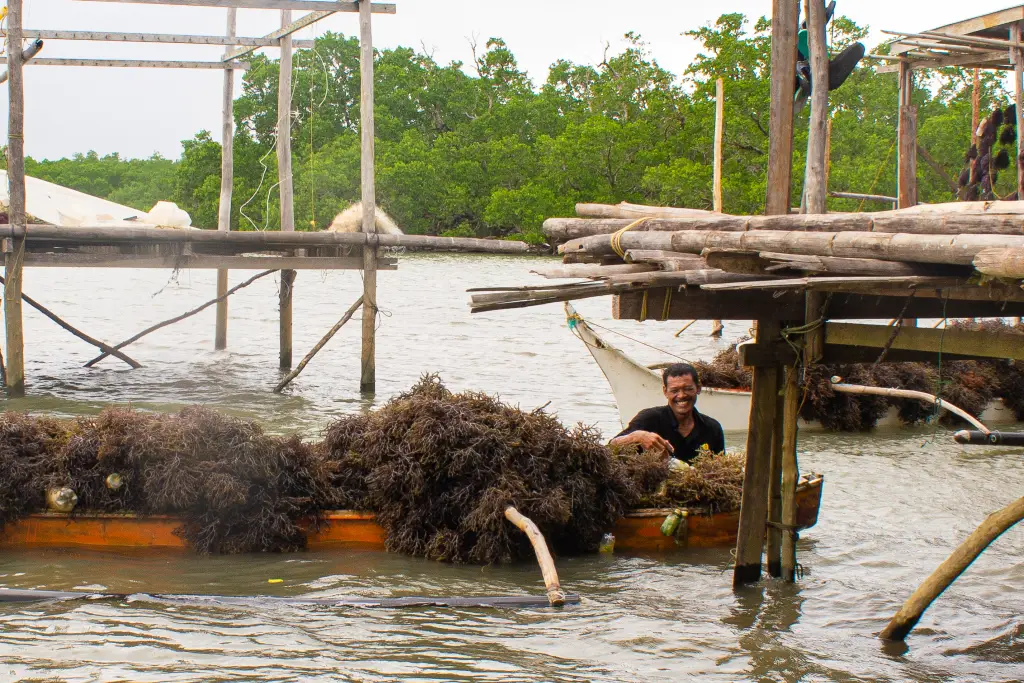
With the collaboration of the BAYER Foundation, this expansion of the Phase II project will contribute to a larger number of beneficiaries. In addition to the current 1,000 families in Hinatuan and San Agustin, Surigao del Sur, 400 new families will be added in Surigao City, Surigao del Norte. The total number of families reached is 1,400, which translates to a beneficiary population of approximately 7,000.
About Bayer Foundation
Bayer Foundation, as Bayer’s corporate foundation, generates impact by supporting breakthroughs in social innovation and science for a world with “Health for all, Hunger for none”. We enable aspiring social entrepreneurs, scientists, students and impact organizations who work in health and food security. Flagship programs of Bayer Foundation are the annual “Women Entrepreneurs Award” and the “Fellowship Program” for life science students and Phds. In addition, Bayer Foundation provides catalytic funding for mature social innovations impacting millions of beneficiaries.
For more information about Bayer Foundation please see Bayer Foundation’s Website: www.bayer-foundation.com.
Entidades que apoyan este proyecto